The Story
The T-Bar Twin Cylinder mechanism
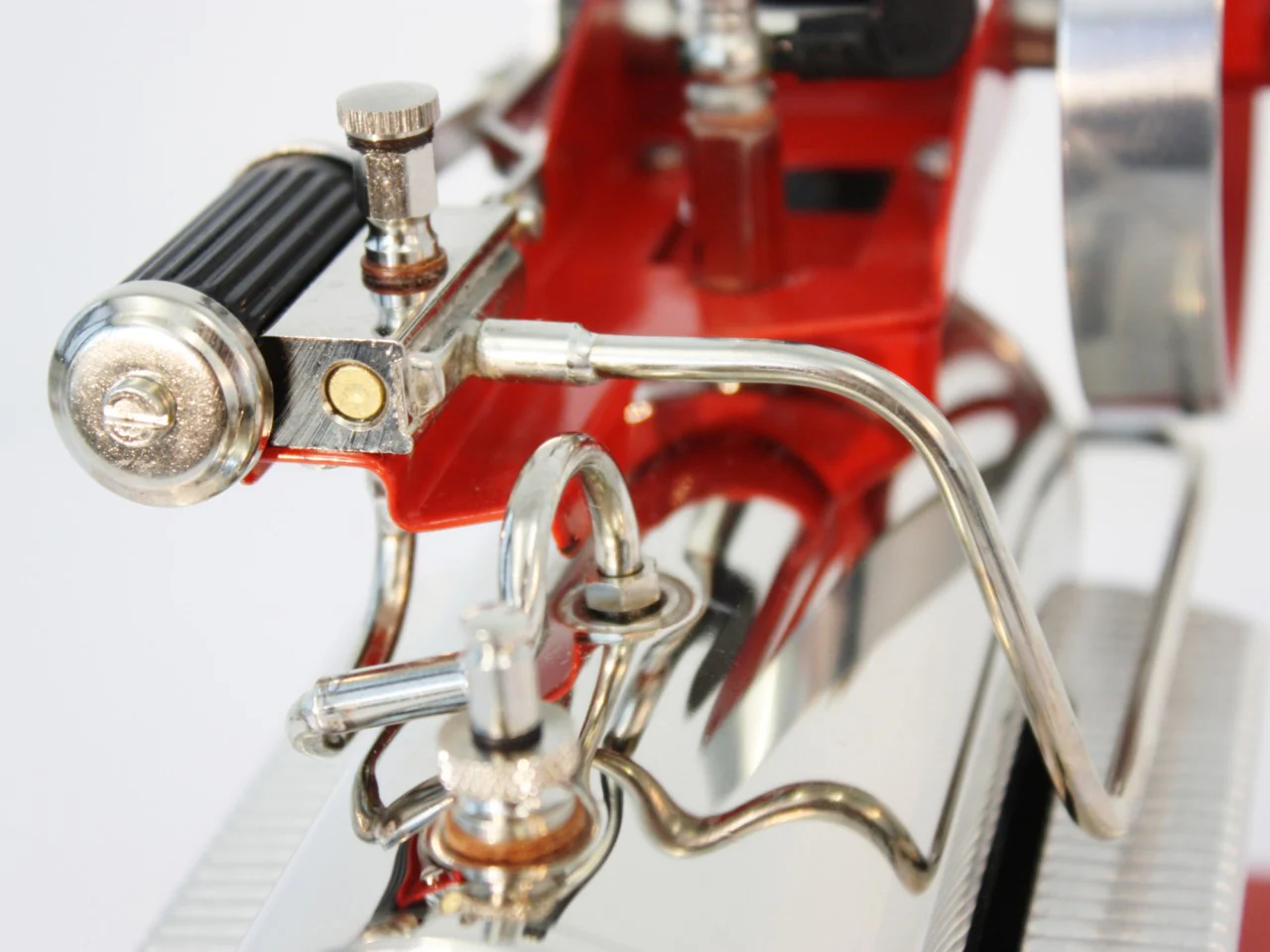
The KS90T Low Temperature Stirling Engine features a unique and mesmerising T-Bar mechanism, which allows two separate power pistons and displacer discs to be connected to one flywheel. One T-Bar delivers power from the pistons, the other T-Bar drives the displacer discs. Each T-Bar pivots on two precision ball-race bearings, and the oval apertures at the top of the T-Bars actuate one precision ball-race bearing.
How does it work?
Stirling engines work by cyclically heating and cooling the air inside the main chamber. As the air heats up it expands, and as it cools down it contracts. This expansion and contraction drives a small piston which in turn drives the flywheel. The clever thing about Stirling engines is that the mechanism for cycling the heating and cooling of the air is built into the engine in the form of the displacer, which is driven by the flywheel and crank arrangement and moves the air from the warm side to the cool side and back again over and over.
The Stirling engine is named after its inventor, Rev. Robert Stirling, who patented his idea in 1816.
Main features:
T-Bar mechanism
Twin cylinder engine
Will run on a 5°c to 10°c temperature difference
Extremely low friction self-lubricating graphite piston
Built in flywheel balancing
Main chamber pillars thermally isolated with nylon screws
Regenerating power piston
Dimensions
Plates - 92mm diameter, 179mm wide, 3mm thick (3.62" x 7.05" x 0.19")
Displacers - 70mm diameter, 7mm thick (2.75" x 0.27")
Flywheel - 82.5mm diameter, 4mm thick (3.25" x 0.16")
Power pistons - 9.5mm diameter (0.375")
Overall height - 160mm (6.3")
PLEASE CONTACT US IF YOU WISH TO ORDER
Description
The T-Bar Twin Cylinder mechanism
The KS90T Low Temperature Stirling Engine features a unique and mesmerising T-Bar mechanism, which allows two separate power pistons and displacer discs to be connected to one flywheel. One T-Bar delivers power from the pistons, the other T-Bar drives the displacer discs. Each T-Bar pivots on two precision ball-race bearings, and the oval apertures at the top of the T-Bars actuate one precision ball-race bearing.
How does it work?
Stirling engines work by cyclically heating and cooling the air inside the main chamber. As the air heats up it expands, and as it cools down it contracts. This expansion and contraction drives a small piston which in turn drives the flywheel. The clever thing about Stirling engines is that the mechanism for cycling the heating and cooling of the air is built into the engine in the form of the displacer, which is driven by the flywheel and crank arrangement and moves the air from the warm side to the cool side and back again over and over.
The Stirling engine is named after its inventor, Rev. Robert Stirling, who patented his idea in 1816.
Main features:
T-Bar mechanism
Twin cylinder engine
Will run on a 5°c to 10°c temperature difference
Extremely low friction self-lubricating graphite piston
Built in flywheel balancing
Main chamber pillars thermally isolated with nylon screws
Regenerating power piston
Dimensions
Plates - 92mm diameter, 179mm wide, 3mm thick (3.62" x 7.05" x 0.19")
Displacers - 70mm diameter, 7mm thick (2.75" x 0.27")
Flywheel - 82.5mm diameter, 4mm thick (3.25" x 0.16")
Power pistons - 9.5mm diameter (0.375")
Overall height - 160mm (6.3")
PLEASE CONTACT US IF YOU WISH TO ORDER